
“The Pretender”… or, The More You Ignore Me, The Closer I Get
True crime’s a fascinating genre. I have to wonder how noted authors such as Ann Rule and M. William Phelps manage(d) to write so many books about murder without losing their minds. I list these two authors specifically because when I Googled “prolific true crime authors,” theirs were the only two names the search results returned.
Not surprising. At all. It’s a soul-sucking process.
Unlike the average novel, true crime requires exhaustive periods of research. Backgrounds, case files, travel, witness interviews, legal considerations, etc. It demands a neutral perspective and the discipline to stay within the bounds of what’s known, not what’s filled in in the absence of established facts. It risks encountering potentially dangerous people or situations. In today’s world, that includes the True Crime Stalker.
You can look it up. It’s an actual thing. There are Reddit threads and YouTube videos that discuss the topic. And we’re not talking the average armchair detective, either.
True Crime Stalker: an internet user who harasses people connected to a live or unsolved case.
The unsolved Keddie Murders could be the poster child for such a term. Its very own True Crime Stalker (TCS) has been at it for decades. He’s scared off witnesses, potential suspects, those curious about the case, and even the victims’ surviving relatives. Several, as a result, refuse to discuss the murders at all anymore – including with law enforcement. At least one witness endeavored to disappear completely.
Not to put the cart before the horse, though. His involvement did not predate mine. I’d first gotten involved with the cold case years before him. I spent eighteen months working with an Indie director on a documentary about the case. It was the first of its kind, and certainly the victims’ families’ first time stepping into the public fray to discuss what happened to their loved ones that horrible spring night back in 1981.
After I exited the project, the director continued on and eventually released the first of two documentaries a couple of years or so later. I was unaware of its release, and unaware of the resultant fallout.
Over a decade later, my mother asked me for my notes. She wanted them for someone who’d become obsessed with the case. He’d assisted the director by creating a website to promote the film and give people a venue to discuss the crime. Because my family has a unique history with the resort town in which the crimes took place, my mother quickly joined the discussion board under the user name “Butterfly Valley.” It was there that this TCS-in-training attached himself to her.
My mother and I’d long since been estranged, so when asked by a third party at her behest for my notes, I refused. It wasn’t merely pettiness. Despite having left the project, I’d developed a close relationship with members of one of the two families who’d lost loved ones that night. It felt like a betrayal (and highly unprofessional) to share personal information. Moreover, the notes were packed away and inaccessible.
When the request was denied, the TCS began pestering my mother to try to get me to talk to him on the phone. Again, I refused. I hadn’t been involved for years, hadn’t followed the doc’s progress, and didn’t realize the project had been finished and released. My mother owned a DVD copy, she told me. However, I declined her offer to let me borrow it.
Then, the nagging began. “Why won’t you talk to him? He knows a lot about the case but wants your perspective.” Eventually, it wore me down. “Fine,” I told her, “give him my number.”
Big mistake. Huge.
That call, twelve years ago now, has become the biggest pain in my posterior.
It came on a Thursday night, May 29, 2014. A rare night that my railroader husband was home. My family and I had already eaten dinner. The grandkids were getting ready for bed, and my daughter was puttering around the kitchen when my cell phone rang. I recall seeing a “702” area code pop up on my phone, so…the Las Vegas area, I figured.
The TCS was abrupt in tone, casting aside the social pleasantries most normal people extend when contacting a stranger. He introduced himself with his moniker – not his name. And with that, he dove in.
I let him know I remembered few details, as I’d been out of the loop for a long time. He asked questions about the director, which I regrettably offered up. Though I’d left for specific reasons, I’d have never divulged information the TCS could later twist and use against the man had I realized that the person with the 702 area code was, in fact, a TCS.
The call abruptly switched from the director to “Who do you think did it?” I told him. He agreed. But then he launched into speculation that the people named were affiliated with the Mob, and that the murders were a professional hit. With that, I knew I couldn’t take him seriously.
Yet on he went. In fairness, he’d clearly conducted a great deal of research, for far longer than I ever had. But when he expressed agitation over my scoffing at the notion that the Mob would have had any motive to stab and strangle a poor, single mom of five, her oldest son, youngest daughter, and the son’s friend, I attempted to end the call. “Seems you’ve got it all figured out,” I told him, rolling my eyes on my end of the line. “I’m not sure why you wanted to talk to me.”
Then, he said it.
I don’t want to put quotation marks around his statement, as I can’t recall it verbatim, but the long and short of it is, he blamed the oldest daughter of one of the victims – a devastated then-14-year-old who’d discovered the bodies – for organizing the murders. Ultimately, he holds her responsible.
Now, I’d gotten to know this woman and several members of her family during my time working the documentary. I spent real time with them. We became close. Like…family close.
It was approximately 10-15 minutes into the call when he made the accusation. I told him he’d crossed a line. I warned him that I wouldn’t continue the conversation if he kept on insulting and blaming her. In true TCS fashion, he doubled down. So, I hung up.
The only reason I remember the specific date of the call was because after I hung up, I emailed the woman in question to alert her about the conversation. I still have that email.
When the family asked me to write the book another decade later, it was connected to this very call. The TCS had contacted everyone he could locate over the years. Almost always acerbic and accusatory in nature. Touting on message boards and his website that he’d teamed up with local authorities and had been granted unfettered access to their files (current administrations have refused similar access to others). More than anything, he had begun regularly and publicly calling out the victim’s daughter, who he now focuses on 24/7. He declared her (along with a growing number of “co-conspirators”) a murderer. His site became the most popular “source” of case information. Few dared challenge him. The banner at the top reads, “Murderers’ Row,” and includes several photos of people associated in one way or another with the area. All in cahoots and all guilty, insists the TCS.
After years of slander, resulting in a handful of internet vigilantes calling for this woman’s prosecution (and worse), the family asked me to do what no one has done. Write a book about the murders, including for the first and only time participation from the victims’ family. The goal? Outline the known facts and allay some of the more egregious rumors started or promoted by this TCS.
I agreed.
For two years, I’ve researched everything I can get my hands on. I’ve waded through ill-informed podcasts, videos, and spin-off books/novels about the crime. All are sourced by information posted on the TCS’s site. In other words: garbage in-garbage out.
And the TCS? He actually moved from Las Vegas (or wherever he’d been at the time) to the county in which the murders took place. He lives there to this day. He’s stood at the graves of the victims. Gotten in good with a handful of unsuspecting locals. It’s disturbing on a number of levels.
Earlier this year, one of the town’s local journalists released a book about the case. His focus was narrower than mine and is a helpful source of key information about the murders. We have since met and conversed on more than one occasion. More than that, he has become an unexpected confidant for information recently gleaned from a third-party source (one of the potentially dangerous sources I’ve mentioned in previous Musings).
Naturally, this journalist’s publication infuriated the TCS. Why? Because he actually believes and states openly that this is his case, and he is the “only one” who knows the truth. Everyone else? Liars. Either that or they’ve “stolen” his work.
I’m sure regular Musings readers can guess what’s happening now.
Yep – I’m in the TCS’s crosshairs, now.
Early on, I wanted to be fair. Telling this story with neutrality required getting the perspectives of many people attached to it (however loosely). As such, I figured I’d give the guy a chance to say his peace. Warts and all. It seemed like the right thing to do. And when he declined, I figured that was that.
It’s not the first time I’ve been wrong.
Lately, the TCS is contacting me via private message on Facebook. At night. Late at night.
Wow. Look at yourself. The same deluded, myopic, indulgently misinformed “expert” on a topic of which you know shockingly little.
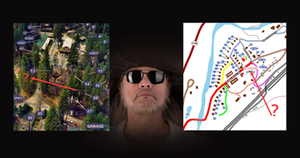
He turned our 15-minute conversation to a “three-hour interview,” and insists that I “lied” about the presence of a house in the resort area where the murders occurred…a resort I lived in. (Note: a detailed map of the area reflects no house where he claims it was – just as I told him.) Somehow, he took what I’m told is over a dozen pages of notes from that call back in 2014. Stunning.
So now, I get a lot of insults. Some veiled threats. And he’s made public hints that he’ll take a digital copy of my finished book and post it for free on his site. He’s done it with another book. He’s also posted pictures of pages of other copyrighted books as well, including the aformentioned journalist who released his book in early 2026. Each he disparages and dismisses as worthless. Interesting, since the TCS could have easily written his own version and put it out. Alas, for all the rage, he’s shown himself to be nothing but a pretender.
As my book on the Keddie Murders nears a fully revised first draft and the anticipated transfer to my editors takes place, I realize that what follows publication will be problematic with this guy. Expensive. Combative. Publicly uncomfortable. I won’t back down, of course, but it will be annoying.
On the other hand, he may be the best marketing tool I could have imagined. Nothing stokes sales like controversy. This guy is it in spades.
All said, I harken back to more prolific true crime authors. For me, this is it. I’ve said it before and I’ll say it again: I can’t wait to return to fiction. But to Ann Rule and M. William Phelps, I must express my sincere admiration. I can only assume their lives and families periodically intersected with psychopaths and dangerous circumstances. That they endured and wrote not one but dozens of true crime stories is a marvel. It hits differently than the one-off true crime authors of even the most fascinating cases.
It’s been a wild ride. However, I long for the day when it’s done, out there, and all the details that my team and I’ve kept in strict confidence can finally be revealed.
With that, I’ll bring this month’s endless Musing to a close. I’m ever hopeful that next month’s news will reflect that the book is progressing definitively to the next level.
Catch you on the flip side.
TTFN